
Hantavirus is less contagious than COVID. Even so, prevention must not be underestimated.
COVID taught us that what we cannot see can have a fundamental impact on our health. Hantavirus is not the new COVID. It does not spread as easily, it has not caused a global pandemic and, for the general population in Europe, it poses a considerably lower risk. Nevertheless, it is a useful reminder that caution and prevention are worthwhile even with infections that are not an everyday news topic.
The main route by which hantaviruses are transmitted to humans is the inhalation of an aerosol contaminated with the urine, droppings or saliva of infected rodents. The risky situation therefore need not be a crowded tram, but rather the cleaning of an old attic, cellar, barn, cottage, storeroom or garage where rodents may have been present. The National Institute of Public Health states that the risk of transmission increases precisely during activities such as agriculture, forestry, gardening, recreational pursuits or the cleaning of cellars and attics.
The case of the expedition vessel MV Hondius, however, showed that hantaviruses cannot all be lumped together. While most of them do not normally spread between people, rare human-to-human transmission has been described for the South American Andes virus. On 11 May 2026, the ECDC reported an outbreak aboard the MV Hondius, where several cases, including a death, were reported in connection with the Andes virus. The CDC also states that the Andes virus is the only known hantavirus capable of human-to-human transmission, usually through close contact with a sick person or during a prolonged stay in a shared enclosed space.
This does not mean we should fear hantavirus in the same way as COVID. It means something else: with infectious risks, it is sensible not to underestimate prevention. Particularly at a time when we know that viruses evolve, change and mutate. The WHO points out that the more viruses circulate, the more opportunities they have to change; some mutations may affect, for example, transmissibility or the severity of the disease.
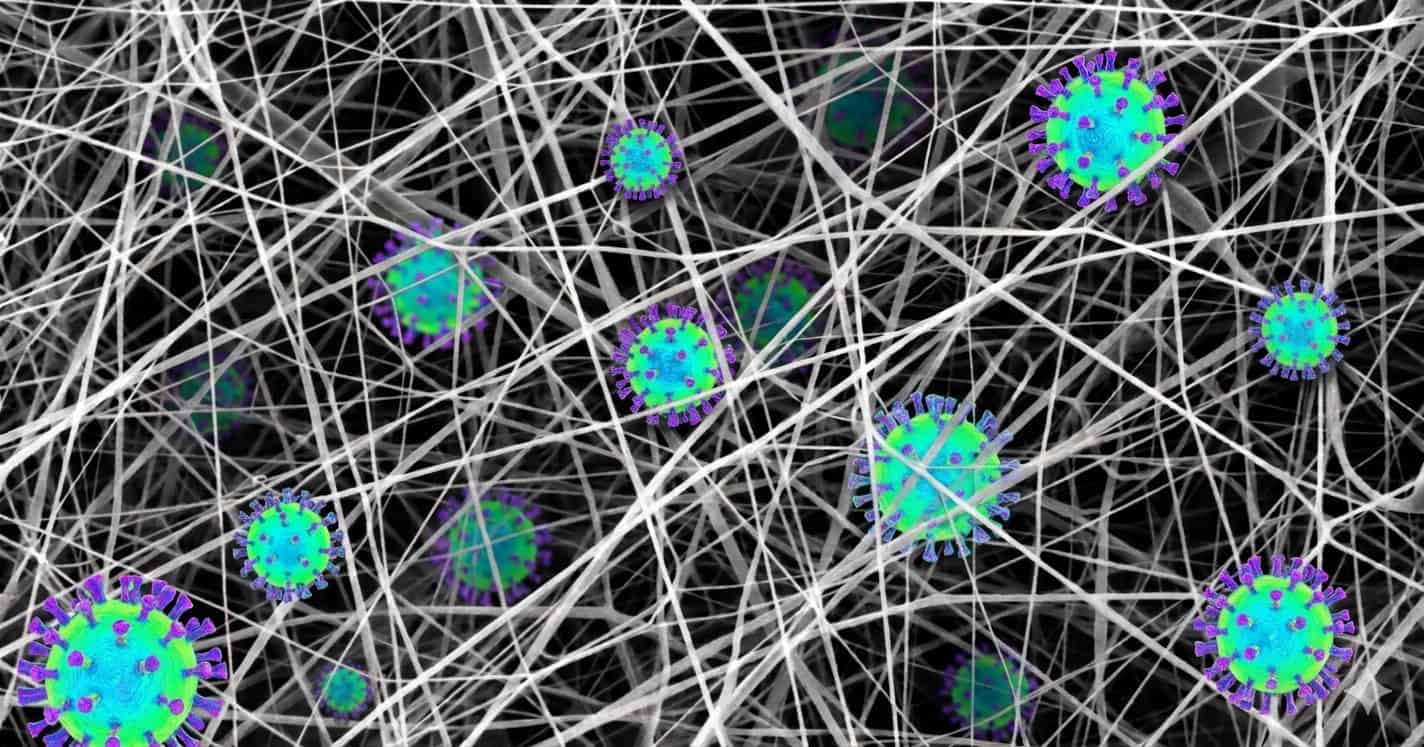
It is precisely here that the importance of high-quality barrier technologies becomes apparent. Nanofibre protective equipment is not merely a memento of the COVID pandemic. It is a premium form of prevention against the inhalation of harmful submicron particles — fine dust, smog, pollen, bacteria, aerosols and particles of a size corresponding to viruses.
When nanometres make the difference
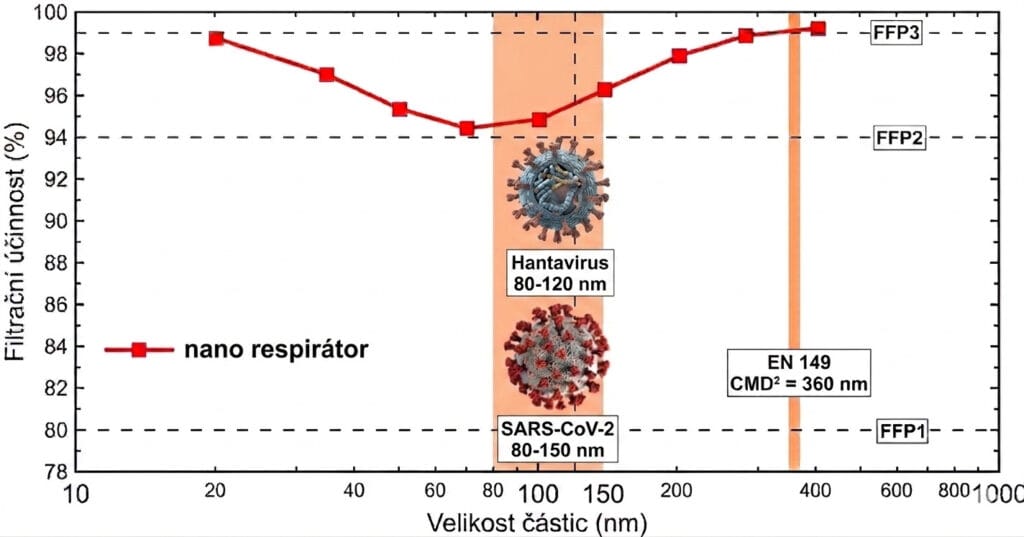
Hantaviruses belong to the enveloped RNA viruses. According to expert sources, their particles are most commonly around 80 to 120 nanometres in size. One micrometre is a thousand nanometres, so we are operating far below the one-micrometre threshold — in a range that the human eye has no chance of detecting, but which the human respiratory tract can capture.
In practice, however, it is not just about the isolated viral particle itself. Viruses can spread in aerosols, droplets, dust or biological material. With hantaviruses, the typical risk is precisely an aerosol from the contaminated excretions of rodents. A person therefore need not “see” any danger. It is enough to stir up dust in a space where infected rodents previously lived.
And it is precisely in this size range that a nanofibre membrane is of exceptional value. It creates a fine yet highly effective mechanical barrier capable of capturing even particles far below the one-micrometre threshold. As a result, it can protect the respiratory tract not only against dust, pollen and bacteria, but also against aerosols of a size corresponding to viral particles.
Why ordinary fabric is not enough
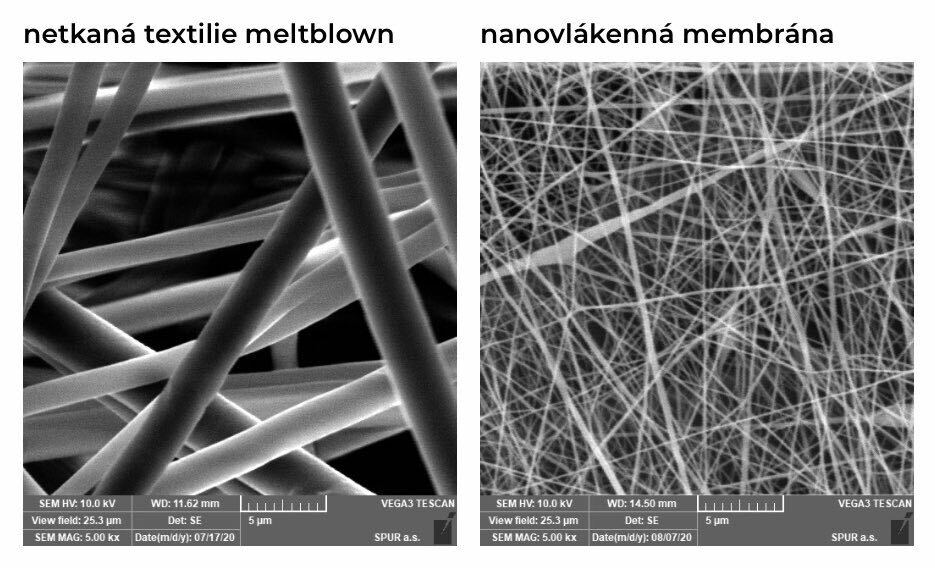
Ordinary fabric can trap larger impurities, dust or droplets, but its structure is too coarse for submicron particles. A nanofibre membrane works differently. It is formed by a dense network of extraordinarily fine fibres on the nanometre scale. Air passes through the membrane, but fine particles are captured in the filtration layer.
This is also important psychologically. During the pandemic, many people grew accustomed to viewing respiratory protection as a one-off crisis aid. Yet protection against the inhalation of fine particles has a far broader significance. It concerns people with allergies, asthmatics, people with weakened immunity and those working in hazardous environments, but also anyone cleaning spaces after rodents, working in a dusty environment or wishing to protect themselves against smog and infectious aerosols.
Here, a nanofibre membrane is not a stopgap solution. It is a technologically advanced barrier protection for a world in which we will repeatedly encounter new and changing pathogens.
Czech companies that know how to capture the invisible
The Czech Republic holds an exceptionally strong position in the field of nanofibre filtration materials. During the COVID pandemic, it became clear that there is an entire ecosystem of companies here capable of developing and producing face masks, respirators, filters, scarves and neck gaiters with a nanofibre membrane. Hantavirus is a good example of why such technologies have not lost their relevance even after the most acute phase of the pandemic ended.
The company SPUR develops the SPURTEX® nanofibre filtration materials. The company states that SPURTEX® PP is a five-layer filtration membrane with an active nanofibre layer made of PVDF polymer, placed between protective layers so that the fine nanofibres are not damaged during use. For the SPURTEX V300 FFP3 nanorespirator, an FFP3 filtration efficiency of 99.4% under EN 149 is stated, together with the capture of ultrafine virus-sized particles in the 30–150 nanometre range.
nanoSPACE has used nanofibre membranes, among other things, in antiviral scarves. In these, the filtration layer is positioned over the nose and mouth area. According to nanoSPACE product information, these scarves contain a nanofibre membrane with a tested capture of viruses, bacteria and other submicron particles of 0.1–0.3 micrometres in size, that is 100–300 nanometres, with an efficiency of 97–99%. This is a size range that overlaps with the dimensions of fine aerosols and virus-scale particles.
For its Nano Med.Clean FFP2 respirators, Nano Medical states the use of AntiMicrobe Web R material and a filtration efficiency capturing more than 99% of viruses, bacteria and solid particles. This is another example of Czech nanofibre protective equipment aimed precisely at capturing fine particles and biological risks in the air.
NANO M.ON is a brand of the company Fermata a.s., not a separate company. For Fermata a.s., the Association lists the antiviral NANO M.ON FFP2 NR nanorespirator with a filtration efficiency of more than 99% for up to 12 hours and a focus on capturing viruses, bacteria, mould, dust and smog.
Dypromed has brought protection in the form of the NANO+ neck gaiter with a pocket for a replaceable nanofibre filter. The Association states that the NANO MED.CLEAN filter in this neck gaiter serves as a two-way mechanical barrier against viruses, bacteria, allergens, smog and other dangerous airborne particles.
PARDAM NANO4FIBERS is among the leading Czech manufacturers of nanofibre membranes for protective equipment. The BreaSAFE® CLASSIC FFP3 respirator is a reusable nanofibre respirator certified to FFP3 under the EN 149:2001 + A1:2009 standard; the manufacturer states a capture rate of more than 99% of airborne solid or liquid particles.
Hantavirus as a reminder of wider prevention
Compared with COVID, hantavirus is less dangerous in terms of ordinary community spread. It is important to say this clearly. For most people it does not pose an everyday threat. At the same time, however, it can cause serious illness, and in certain situations the risk is real: through contact with rodent excretions, when cleaning infested spaces, in an enclosed and poorly ventilated environment, or, exceptionally, through close contact with a sick person in the case of the Andes virus.
Prevention is therefore not a sign of panic. It is a sensible response to a risk that, while not widespread, can have serious consequences. Just as we put on gloves when working with chemicals and protective goggles when cutting wood, it makes sense to protect the respiratory tract wherever an infectious aerosol or fine dust may arise.
In this respect, nanofibre protective equipment is a premium choice. Its purpose does not lie in promising absolute protection against a specific disease. Its strength lies in a highly effective physical barrier against the inhalation of fine particles. And it is precisely this barrier that can prove decisive at the moment when we do not know exactly what is present in the dust, the aerosol or the enclosed space.
In an age of mutating viruses, barrier protection remains relevant
The COVID pandemic showed that viruses can quickly move to the centre of world events. Hantavirus shows something different: that infectious risks can also exist quietly, locally and inconspicuously. It does not have to be a mass pandemic for prevention to make sense.
We live in a world where viruses evolve, where ecosystems change, where people travel, venture into the wild, occupy ever closer quarters with animal reservoirs, and where new information about the transmission of infections emerges continually. We cannot simply rely on today’s risk remaining the same tomorrow.
This is precisely why a technology matters that does not rely on recognising one specific virus, but on the physical principle of capturing fine particles. A nanofibre membrane does not wait until we know the name of the pathogen. It creates a barrier against the particles trying to enter the respiratory tract.
And that is its greatest benefit. Czech nanofibre face masks, respirators, antiviral scarves and neck gaiters are not merely the product of a single pandemic experience. They are part of modern prevention for an era in which we know that invisible particles can have very visible consequences.
Hantavirus may not be the new COVID. But that is exactly why it is a useful warning: not every risk has to be widespread to be worth protecting against. And if there is a Czech technology able to create a premium mechanical barrier against the inhalation of submicron particles, it makes sense to use it wherever prevention can make the difference to our health.


0 Comments