

The Czech company LAM-X has developed nanofibre filters that not only capture bacteria but also kill them once illuminated with blue light. The technology tackles a problem that conventional filters struggle with – the build-up of bacteria and the formation of biofilm. Just five years after its founding, the company is already in talks with leading global players in the filtration industry.
From Medicine to Filtration: An Evolving Strategy
LAM-X was founded in 2020 as a joint project between Charles University, through Charles University Innovations Prague (CUIP), and the Institute of Organic Chemistry and Biochemistry of the Czech Academy of Sciences, through the i&i Prague bio-innovation centre. The company initially focused on developing medical devices for wound care, where the technology was intended to prevent secondary infections in hospitalised patients.
Two years ago, however, the company strategically broadened its focus to filtration. “We observed that hospitals have a significant problem with patient-acquired infections. We successfully developed an innovative nanofibre material that addresses this problem. Given its success, we extended its use to other areas where airborne bacteria can cause problems. Filtration media were the ideal next step for our solution,” explains Roman Chaloupka, CEO and CTO and a PhD in molecular biophysics, in an interview for International Filtration News.
In June 2025, LAM-X was cited as one of the success stories of the Czech biotechnology sector when the i&i Biotech Fund, backed by the European Investment Fund and managing over CZK 1.2 billion, invested in this promising Czech company.
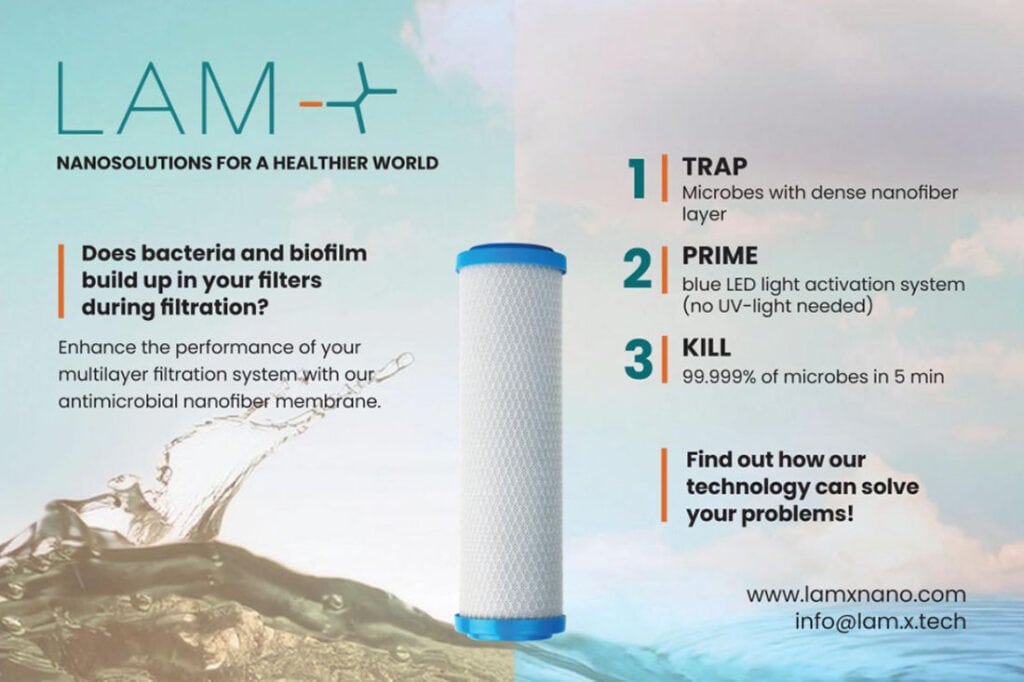
How the Technology Works: A Three-Step Active Disinfection Process
LAM-X technology represents a step forward compared with conventional passive filters. The material is a membrane made of polymer nanofibres – the company offers both synthetic and biodegradable variants. The key component is a small organic molecule called a photosensitiser, encapsulated directly within the nanofibres.
The antimicrobial function takes place in three steps. First, bacteria or viruses are captured in the dense network of nanofibres, just as in any other passive filtration material. Second, a flash of blue visible light (not UV) is directed at the membrane, activating it. The light activates the photosensitiser molecules in the fibres, which convert molecular oxygen into its reactive form. This then eliminates the bacteria or viruses trapped in the nanofibre network.
“The entire process can run virtually continuously, because the active substance itself is not depleted during the process. A huge advantage is that the effect of this reactive form of oxygen is non-specific, so it kills absolutely all microorganisms captured on the membrane, and unlike antibiotics, no resistance to it develops,” Chaloupka emphasises.
Biodegradability as a Competitive Advantage
A fundamental benefit of LAM-X technology is that the nanofibre is made of biodegradable polymers without any antimicrobial activity relying on heavy metals such as silver or other toxic chemicals. This special fibre has been proven to kill all types of bacteria regardless of their resistance.
“In the world of antimicrobial solutions, bringing a new solution to market should be done with the utmost caution because of resistance to antibiotics and disinfectants. Solving the problem of bacterial contamination can have unintended negative consequences. Our material releases no heavy metals or toxic chemicals and is able to capture and kill any bacteria, including resistant ones, which are the most dangerous. We know it triggers no resistance to this treatment. It is a solution for the future,” Chaloupka explains.
The company has both variants of the material available. In certain cases the synthetic version is necessary, but it also has an environmentally friendly membrane made of biodegradable polymers, which is in keeping with the company’s principles. “We have come a long way in comparing the quality of biodegradable and synthetic nanofibres, and we are proud of the quality of our membranes,” he adds.
Eliminating Biofilm: Key Value for Filtration
LAM-X technology operates in the critical space of filtration thanks to its antimicrobial component. This is likely to have a significant impact on the ultrafiltration market, where filtration is typically combined with antimicrobial solutions.
“Our confidence in the technology stems from the fact that we repeatedly hear that our unique selling point resonates with the problems our partners face in their fight against bacteria. The accumulation of bacteria in filters is not aggressively addressed by current solution providers. Our technology eliminates bacteria so effectively that it prevents the onset of bacterial clogging and biofilm formation, which is one of LAM-X’s greatest advantages,” says Chaloupka.
The company is able to combine several systems into a single step, thereby reducing space requirements, saving electricity and cutting the costs associated with biofilm.
Partnerships with Leading Market Players
LAM-X currently operates in the B2B space and is in talks with major players in the filtration industry. “At the moment we are in the development phase with one partner in the area of ultrapure water preparation, and we are in negotiations with one of the top three players in the filtration market. We are looking for further partners willing to innovate in water and air filtration, but of course we also see opportunities for growth and for implementing our technology in other areas in the future,” the CEO reports.
The company is currently developing ultrafiltration solutions for the water and beverage industry, but there are other applicable categories such as food, gases and liquids, and even areas such as crop protection.
Testing to International Standards
All products, including filters and medical devices, undergo thorough testing of their antimicrobial activity against various types of viruses and bacteria, for example E. coli and multidrug-resistant Staphylococcus aureus, both in-house and in accredited laboratories.
LAM-X materials are tested to international standards, including – among others – ISO 2743 for antibacterial activity against both gram-negative and gram-positive bacteria, ISO 18184 for antiviral activity and ISO 22612 for bacterial penetration.
Vision: A Standard in the Global Filtration Industry
“I see LAM-X technology as an integral part of standard solutions in the filtration industry, and I hope that by working with major players in the field we are already on the path to this goal,” Chaloupka looks ahead with confidence.
With its current focus on water filtration and its entry into the air filtration market, the market is large enough to ensure that LAM-X solutions can soon be integrated into many different sub-sectors. The company will continue working towards multi-market applications as its success in specific markets grows.
The technology’s high safety profile, originally meeting the strict regulatory criteria for medical devices, also provides confidence for applications in the filtration industry.
From Academic Research to Commercial Practice
The story of LAM-X is a successful example of technology transfer from Czech academic institutions into commercial practice. The company combines academic research with practical solutions to specific industry problems, while placing emphasis on sustainability and environmental responsibility.
As part of the growing Czech biotechnology ecosystem, which also includes other successful companies backed by the i&i Biotech Fund, LAM-X shows that Czech nanotechnology companies can compete on the international market.
The company’s motto, “Our solution solves your problems without creating new ones”, captures its philosophy – to offer an effective antimicrobial solution with no negative environmental impact, no risk of resistance developing and minimal operating costs.
Sources of the photographs used in the article:
https://www.linkedin.com/company/lam-x/posts
Capturing Dangerous Bacteria

0 Comments